search,search,search

Google
 

Monday, November 13, 2006

PATAGONIA


Global Warming in Patagonia
A region that expects arrival of millions of "climatic refugees"

Recently it has become common during weather reports in Chilean television, newspapers and other media to inform about the levels of Ultra Violet (UV) Radiation. The degree of danger faced by humans when exposed to the harmful UV rays is measured from 1 to 12, or from low (white color) to very high (dark red color). For example at the time this article was written, the levels in Santiago, the Chilean capital were reported at level 8 or high. The Chilean Cancer Institute (www.Conac.cl) has recommended that people should take care between 11:00 a.m and 3 p.m, when UV radiation is at its highest levels and the risk of contracting skin cancer or vision problems are greater. Men and women have been discouraged from "sunbathing" in beaches or swimming pools, as even if the aesthetic effect may be attractive, experts agree that the probabilities of contracting cancer are high. According to statistics given by Conac, the rate of skin cancer cases in Chile increases by 3% each year. Conac has also begun a campaign where a bracelet known as "Sun Alert" is sold to children for US$2 dollars, to help youngsters become aware of the dangers of overexposure to sunlight. According to measurements carried out by Conac, the levels of solar radiation for January 2006 were higher than in January 2005, and the color used for this period was violet (extremely dangerous). Conac estimates that due to the reduction in the ozone layer, by the age of 18, a Chilean individual has already been exposed to radiation that normally would have been received in 50 years. Since 2004, Conac has set up several UV ray sensor equipment in beach resorts all over Chile.
Recently the local Dermatologist Society has warned against the exposure to UV rays in solariums, ( another popular practice) since "the skin is directly exposed to UV rays".
In the central region of Chile, where most of its population is concentrated, the global warming phenomenon has caused abnormally high temperatures during winter, from May to September, and at present some lower temperatures and cloudier days have been experienced since October, when the temperatures are normally higher.
Also the higher temperatures have caused an increase in rat population in rural areas. This has provoked the appearance of an until now unknown virus, "Hanta" that is contracted when humans come into contact with areas infested by rats. This year, several people have died from Hanta and the authorities have launched public information campaigns to on how citizens can prevent the transmission of this disease.


In the Patagonia, in the far south of the continent and only two hours by plane from the Antarctic, the levels of UV radiation area are much higher, since the gap in the Ozone layer is directly over this territory that is shared by Argentina and Chile. Citizens on both sides of the border are exposed to the same levels of radiation and so people of all ages have become used to wearing sunglasses all year round. This situation became more apparent after sheep farmers noticed that high levels of exposure of UV rays were blinding many of their animals, as the sheep remain grazing all day in the fields. During winter, the Antarctic region is isolated from the continental winds due to the "Polar Jet", a phenomenon where a circular mass of intense winds causes the lowest temperatures in the planet and also the highest losses of Ozone. Polar clouds containing high contents of chlorine are formed that prevent the UV radiation from being filtered by the Ozone layer, since one molecule of chlorine can destroy thousands of molecules of Ozone. Along with many other countries, Chile and Argentina have set up scientific bases in the Antarctic and are constantly monitoring the situation in the ozone layer.


Global warming has also caused geopolitical tension between Argentina and Chile such as occurred in 2006 over the "Southern Ice Fields". These glaciers are located in the Andes Mountains approximately 1000 kms from Santiago, the Chilean capital and are one of the largest water reserves in the planet, but since they are exactly on the border between the two countries, the border has not yet been officially established. Argentina caused a diplomatic incident after its Ministry of Tourism published a map in its website where all the "Southern Ice Fields" appeared as Argentine territory. Chile complained to the Argentine government and the map was taken off the website. These glaciers are constantly melting at an alarmingly fast rate, creating large blocks of ice that increase the level of the seas.
It is estimated that during the next 50 years, the temperatures in the planet will increase by 2 degrees Celsius, causing a negative impact on the planet's agricultural production and obviously a shortage of food. Argentina, Chile and Brazil will be faced with the arrival of millions of "climatic refugees" from all over the world as land mass, water supplies and food production decrease.

Sunday, November 12, 2006

Chilean Footballers


Jeonbuk Hyundai Hires Jose Luis Villanueva

Villanueva is a 25 year old forward that was recently playing for Morelia in the Mexican First Division. The Chilean striker played 16 matches for Morelia during the “Opening Tournament” and scored 4 goals. Villanueva must be in Korea on January 4 to start training with his new club, Jeonbuk, the Korean and Asian champion that also took part in FIFA’s World Club Championship some weeks ago. Villanueva was also wanted by Argentine First division clubs such as San Lorenzo and Racing, and in this last club he played during the 2005 season so many were surprised by his decision.
“When the Koreans contacted me I didn’t think twice about it. I accepted immediately and I don´t care when people say that the Korean league is not very well known. They forget that Korea was third in the 2002 World Cup, there are Korean players in the English Premier League. I like the challenge of seeing a new culture, maybe I will also become a businessman. The Korean style of play is fast and strong and I like that,” said Villanueva during an interview with Chilean newspaper “Las Ultimas Noticias”.
Villanueva’s manager Leo Rodriguez stated to the press that “the one year contract arrived by fax from Korea and the salary is quite high, but I cannot reveal how much Jose luis will earn,”
Villanueva started his career as as footballer in Chilean clubs Palestino, Cobreloa and Universidad Catolica.


Arsenal Fires Three Goals Past Liverpool
Chile´s Mark Gonzalez is replaced in second half.

Arsenal played its 6th English Premier League match at the recently built "Emirates Stadium" on November 12th in front of a full capacity crowd of 60,110 spectators. This is the most modern stadium in the world and was built at a cost of 580 million euros. The main sponsor is "Emirates airlines" and part of the deal with the London club is that the airline will have the main publicity rights for the next fifteen years.
Arsenal is getting used to playing at its new stadium, and its form has not been as good as at Highbury, since in the past 5 matches the "Gunners" have won two matches and drawn three. On the other hand Liverpool has had a very bad record as a visitor with only one draw and five defeats. The local press rumors that coach Rafa Benitez may be near to losing his job if the results continue to be negative. Benitez made a lot of Chilean fans when he put on Mark Gonzalez on from the first minute, even if the Chilean midfielder is recovering from muscle fatigue. The match began at a nonstop pace and it was Liverpool that had the first scoring chance as Dirk Kuyt´s shot went over the Arsenal goal defended by Manuel Almunia. It was interesting to see that both teams have Spanish goalkeepers and that Arsenal did not field any English players, instead several French players, , two Ivorians a Bielorussian ( Alexander Hleb) , and Gilberto Silva, a Brazilian defender that along with Gonzalez were the only South Americans on the pitch.
Both teams played with a man to man marking system that left very few open spaces for Mark Gonzalez or any other player to run freely. Gonzalez was yet again the only dangerous striker for Liverpool, with a dangerous low cross from the left in the 27th minute to Boudewijn Zenden , that sent the ball over the crossbar.
However it was Liverpool that made the first defensive mistake that cost them the first goal by Arsenal. Hleb ran into the Liverpool area and made a good pass to Francesc Fabregas that in turn crossed a low ball to Mathieu Flamini whose shot gave Arsenal the lead after 40 minutes of play.
Liverpool controlled the first ten minutes of the second half in a desperate attempt to equalize but another defensive error in the 55th minute sealed the fate for the northern club. Robin Van Persie saw a space in the Liverpool defense and made a long pass to Kolo Toure that was left alone in front of Jose Reina and hit a low shot into the left corner of the net.
In the 60th minute, Rafa Benitez made another questionable substitution as he replaced Mark Gonzalez , the only man that had created danger for Liverpool in the left wing, and replaced him with Jermaine Pennant (that usually plays on the right wing).
Peter Crouch, that along with Kuyt had not shown much during the match was substituted by Craig Bellamy in the 70th minute. A curious note was added to the match as referee Mark Clutterbuck fell to the ground the next minute with an apparent knee injury, but the man in black was soon recovered by the medical assistants. The deathblow to Liverpool came ten minutes later as Van Persie took a corner from the right and incredibly William Gallas was left alone to head the ball past Reina. Liverpool's defense is its weak point this season, and no team can do well if they give advantage in this area of the field. The rest of the match continued with Sami Hyypia being substituted by Philippe Senderos and an on-the-pitch argument between Steven Gerrard and John Riise. Arsene Wenger´s tactics were superior to those of Rafa Benitez, whose days as Liverpool coach seem numbered.

Starting Lineups :

Arsenal (3) : Manuel Almunia, Emmanuel Eboue, Kolo Toure, William Gallas, Gael Clichy, Gilberto Silva, Francesc Fabregas, Robin Van Persie, Mathieu Flamini, Alexander Hleb, Thierry Henry.
Coach: Arsene Wenger

Liverpool (0) : Jose Reina, Sami Hyypia, Daniel Agger, Jamie Carragher, Xabi Alonso, John Arne Riise, Steven Gerrard, Mark Gonzalez, Peter Crouch, Dirk Kuyt, Boudewijn Zenden,
Coach : Rafa Benitez.

Chile´s New Generation Of Footballers
Who are they and where are they playing?

Like the majority of South American players, Chile´s professional footballers are tempted to emigrate to Europe in search of higher salaries and living standards. Never has there been so many Chilean players playing in foreign leagues and along with the election of a top FIFA official such as Harold Mayne -Nicholls to head the local federation and who promises to bring about radical changes, the stage is set for Chilean football to get back on the map. As follows is the list of the Chilean players and their clubs:

Italian Serie A ( First division) :

David Pizarro, Roma F.C : On Nov. 12, this midfielder played during the whole match against A.C Milan and helped his team to an important 2-1 victory over one of Italy's most famous clubs. Roma is also taking part in this year's edition of the UEFA Champions league.


During the last qualifying round for Germany 2006, Pizarro resigned from Chile´s national team after quarrelling with the coach but now it seems he will reconsider and return to help his country qualify for South Africa 2010.

Nicolas Cordova , Messina
: Another rebel that has refused to play for Chile due to personal differences with the coach, Cordova is a midfielder that has won a regular place in his team. Messina is currently in seventh place in the Serie A and with the forthcoming change of coach in the national team, Cordova has shown his willingness to play for Chile again .

Jaime Valdes, Lecce : Even if his team is in the second division, to be playing in Italy means that Valdes has been exposed to higher requirements and must surely be considered to play for Chile.

English Premier League :

Mark Gonzalez, Liverpool : Has been showing great form at one of England's top clubs and is winning the approval of the local fans. Also refuses to play for Chile (due to an act of indiscipline) but this striker will surely return when the new national team coach is appointed.

Scottish Premier League :

Mauricio Pinilla, Hearts : This striker was once considered the great young promise of Chilean football. After passing through several clubs in Italy, Spain and Portugal, it seems Pinilla is finally maturing and is settling down to his new club. Also a sure shot to play in the national team.


Spanish Liga Primera (Premier League) :

Claudio Bravo, Real Sociedad : Bravo is at present the first choice goalkeeper for the national team, and during his first season in Europe, is sure to gain valuable playing experience for the future.

Pablo Contreras, Celta : A defender with many years experience in Europe, has won a regular place in this club that recently defeated Real Madrid by 2-1 in its own stadium.


Portuguese First Division :
Rodrigo Tello, Sporting Lisbon : This midfielder has won a regular place in the squad, and has shown good form during this year's edition of the UEFA Champions League. A player of Tello´s experience cannot be overlooked by the new national team coach.

Alex Von Schwedler, Maritimo : Before moving to Europe he played many seasons for Universidad de Chile, one of the country's top clubs. Von Schwedler is a reliable defender that has helped his team to be in fifth place of the points table.

Dutch First Division:
Sebastian Pardo, Feyenoord : Pardo has been playing for several seasons in one of Holland's most popular clubs, so this midfielder cannot be left out of the Chilean national team lineup.

Brasileirao ( Brazilian first division) :

Jorge Valdivia, Palmeiras : Just to be chosen to play in the most competitive league in the world is a major achievement, but Valdivia has done more than that, he has become a favorite with the local fans due to his skilful "Brazilian" style of play in midfield.

Claudio Maldonado , Santos : A defender that has made a name for himself in the Brazilian championship after several years. A regular in the national team but that is nearing the end of his career.

Alejandro Escalona, Gremio : Also playing for one of Brazil's top clubs, Escalona is a midfielder whose club is fighting for a place in next year's edition of the Libertadores Cup (South American Champions league).

Mexican First Division :

Reinaldo Navia, San Luis : Like many other Chilean players, Navia was attracted to this up and coming league due to the high salaries paid by clubs. Navia is a dangerous striker that has been a regular with the Chilean national team.

Sebastian Gonzalez, Tigres Monterrey : Another goal scoring striker that has been highly successful in Mexico and just cannot be left out of any future lineup.


Hugo Droguett, Tecos de Guadalajara:
Recently transferred from Universidad de Chile, Droguett, an attacking midfielder has scored four goals during fifteen official matches in the Mexican league.

Hector Mancilla, Veracruz : Like Droguett, Mancilla was hired to Mexico at the beginning of 2006 and is doing his job as a striker with six goals in thirteen matches.


Chilean First Division :

Humberto Suazo , Colo Colo : Recently chosen by FIFA as one of the world's top strikers, Suazo has nothing else to prove in Chile and at the moment is considering several proposals by foreign clubs.

Matias Fernandez , Colo Colo : The golden boy of Chilean football. A skilful midfielder that was transferred in October to Villarreal of the Spanish first division, but will play for Colo Colo until January 2007.

Friday, November 10, 2006

CHILEAN SPORT

144th-ranked Andreev upsets fifth-ranked Gonzalez
In first-round Davis Cup action this weekend, Russia defeated Chile at home in the resort city of La Serena, Chile.In the first of two singles matches on Friday 4 sept, Marat Safin of Russia (ranked 24th) beat Nicholas Massu of Chile (ranked 42nd), 6-3, 6-2, 6-2. Massu has shown a slump in his form in the past year. As is tradition, the local team had been allowed to choose the location and pitch. The Chileans had picked a clay surface at sea level in an effort to slow down the hard-hitting Russians.In the next game, local fans were certain that Fernando Gonzalez, the world's No. 5 player, would easily overcome Igor Andreev, ranked 144th. Against all odds, however, Andreev struck a heavy blow to the home team's morale, defeating Gonzalez in three straight sets.The Chilean team went to rest that night without disclosing who would take part in the doubles match.A few minutes before the start of the game on Saturday morning, the crowd of 9,000 cheered as they saw that Gonzalez and Massu would try to keep Chile in the series. The two Chilean players have been playing together since the junior division. In 2004, they won the gold medal in doubles at the Athens Olympic Games.The Russians, Safin and Andreev, were no match for the Chileans, who won 7-6, 6-3, 6-4. Now all was set for the final and decisive match day, when Gonzalez would face Safin and Massu would play against Andreev.Gonzalez recovered his form on Sunday and defeated Safin, 6-3, 7-5, 6-4, boosting the crowd's spirit.Now all the attention was focused on whether Massu could defeat Andreev, the surprise player of the series. The Russian started by playing nearly perfect tennis at the beginning and won the first two sets, 6-2, 6-1. Spurred on by the local fans, Massu made a comeback in the third set to win, 7-1, in the tiebreak. Unfortunately, in the fourth set, Andreev played as well as he did earlier, winning with a final score of 6-2, 6-1, 6-7, 6-4.Chile must now await the draw by the International Tennis Federation to see which country will be its rival in September. Whoever it might be, Chile must win in order to continue in the top flight of world tennis.Other 1st Round ResultsArgentina 4, Austria 1USA 4, Czech Republic 1France 4, Romania 1Germany 3, Croatia 2Spain 3, Switzerland 2Sweden 3, Belarus 2Australia 2, Belgium 3


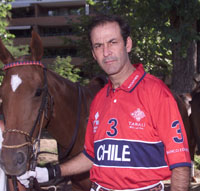
Chile’s Top Polo Player Dies After Freak Accident
Gabriel Donoso Was A Good Friend Of Prince Charles
(Photo by La Segunda.com)
The Fleni Clinic in Buenos Aires, Argentina informed that on November 10, Gabriel Donoso, Chile´s best polo player of all time, had been confirmed dead at 05:45 a.m.,. On, Nov.5, Donoso, aged 46 had suffered an unusual accident as he trained with his horse some minutes before a match in Pilar, a suburb on the outskirts of the Argentine capital. According to TV news reports, the horse became nervous and threw Donoso onto the ground. Donoso broke his spine and had been in coma and breathing through artificial ventilation.
Gabriel Donoso was also considered one of the best polo players in the world alter having achieved a handicap of nine goals, a mark that very few polo players can boast. Another of his feats occurred in 2004 when he led Chile to defeat England by 10-8 at the Guards Polo Club in London. On that occasion Donoso was honored to receive the trophy from Queen Elizabeth II and Prince Charles, of whom Gabriel Donoso was a close friend and teammate. Donoso was married to a english woman and leaves two children.
Also known as the “Sport of Kings”, Polo originated in what is now Iran and is the most exclusive sport, placed only by high income individuals and royalty. At present only a few countries Duch as U.S.A, Argentina, England, Pakistan and Australia have professional tournaments. Argentina won the World Cup since 1949 and most of the 10-goal (highest ranking) players are from this South American country. Also Argentina’s “Campeonato Abierto de Polo” (Polo Open) is one of the most prestigious in the world and has been played for the past 100 years.

Monday, November 06, 2006

CHILEAN NEWS


The relationship between Salvador Allende and Augusto Pinochet
Chile´s most influential figures in the 20th century

How General Augusto Pinochet´s spent his last day on earth would be the best way to describe his whole life , one full of controversy and conflict. After being officially pronounced dead at 2:15 p.m. on Sunday December 10, Pinochet´s body was taken to the Military Academy in Santiago, where it was displayed in a coffin surrounded by a guard of honor formed by Army cadets. From that moment on thousands of his supporters gathered outside the building and were allowed to line up and walk past the coffin to pay their last respects, and the procession continued until the next day. Official estimates are that at least 60,000 people walked by Pinochet´s coffin. The funeral ceremony was carried out on Dec. 11, but President Michelle Bachelet only allowed a funeral as Head of the Armed Forces. According to an opinion poll carried out by " La Tercera", one of Chile´s most influential newspapers, 72% of those questioned were against calling for a national mourning period and 55% were against giving Pinochet a State Funeral.

Many foreign journalists had gathered to cover the event outside the Academy and were attacked and insulted by Pinochet´s supporters, as were many local reporters. Maria Jose Ramudo, a journalist with a Spanish TV station was carrying out a live transmission to her country when objects were thrown at her. A man identified as Rene Araya took the microphone away from her and shouted high caliber insults against Spaniards.
On Dec.14, Araya gave a press conference at the Chilean Journalists Association where he publicly apologized to Spain and the Spanish people for his behavior. Also an Argentine journalist that was broadcasting to his country, mentioned that "Pinochet, the Chilean dictator is being mourned in this building" and was physically and verbally attacked by Pinochet supporters. Most Pinochet supporters blamed the press for all of Pinochet´s legal problems. During the funeral ceremony, Pinochet´s grandson, an Army captain also named Augusto, gave an improvised speech where he praised his grandfather for "saving Chile from the Marxist regime" and criticized the Chilean Supreme court for "harassing his grandfather and his family". The next day Captain Augusto Pinochet was expelled from the Chilean army. After the speeches and a brief march in a horse drawn carriage, Pinochet´s body was taken aboard a helicopter and flown to a cemetery in Vina del Mar, 130 kilometers to the west of Santiago, where Pinochet was cremated and his ashes were handed to the family. The destinies of Allende and Pinochet were linked from the beginning, since by a strange twist of fate, both were born in Valparaiso, Chile´s main seaport . Allende (born in 1908) was the son of a lawyer that also had the privilege of being a "Notary Public", a much-coveted position in Chile due to its high income. Pinochet (1915) was the son of a Port Customs inspector and as a child was educated in Roman Catholic schools.
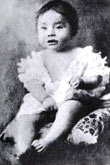

After ending secondary education, Pinochet applied for entry to the "Military Academy" in Santiago, where he was finally admitted after a third attempt in 1933.
In the same year as Pinochet began instruction at the "Military Academy", Salvador Allende had graduated from the faculty of medicine at the "University of Chile", the country's most prestigious establishment of higher education. By this time Allende was also a high ranking member of the "Freemason Society" a very influential organization in Chilean society, while Pinochet was rejected entry into the Freemasons.
While Allende was heading for a successful and glamorous political career in the Chilean congress, Pinochet was stationed in different points of the country as an Army officer, in charge of provincial regiments far from the capital. However, in 1943, Pinochet took a step that changed his fortune since he married Lucia Hiriart, the daughter of an influential politician, that convinced her father to exert his influence and obtain better postings for her husband.
In 1945 Allende is elected "Senator" and also becomes the leader of Chile´s left wing coalition of parties. During the middle of the 1950´s , the Chilean government, following the example of Senator MacCarthy in the United States, outlaws the Communist Party and many of its members are sent to prison camps, one of which is headed by Augusto Pinochet . In 1961 Salvador Allende meets for the first time with Ernesto "Che" Guevara , while Pinochet travels to "The School of the Americas" in Panama, a training center run by the U.S Army where Latin American officers are trained in counter insurgency methods. Pinochet specializes in "Intelligence Operations" and many of his classmates will also become the rulers their respective countries during the 1970s.
In September, 1970 during his third presidential campaign, Allende is the highest voted candidate with 36.6% and according to Chilean law is the winner of the election. Initially Allende wanted to maintain good relations with both the Western and Eastern Blocks, but his decision in July 1971 to nationalize the local copper mines, ( the world's largest deposits), earned him the wrath of the Richard Nixon administration since the majority of the mines were owned by U.S. companies. Immediately Nixon blocked all financial credits to Chile and ordered covert operations aimed at collapsing the Allende government. At this point the Allende government strengthened its ties with Soviet block and the conflict intensified. Meanwhile Augusto Pinochet had reached the highest ranks of the Army and apparently had won the confidence of Allende that appointed him Commander in Chief of the Armed forces on August 25, 1973. Until then Pinochet had given the impression of being loyal to Allende, but in fact he was a master of deception that had already began to plot the military intervention that reached its climax on September 11, 1973.
Salvador Allende died that day in the presidential palace without knowing that Pinochet was heading the armed "Coup d' Etat". Such was the conspirational skill of Pinochet that only a few high ranking officers such as the head of the Navy and Air Force knew that he was part of the plot.
During his first days in power, Pinochet was appointed head of the military "Junta" (group of leaders) and promised that new presidential elections would be held as soon as possible. However, his behavior arose suspicions when Pinochet set up a new organization called "National Directorate of Intelligence " (DINA in the Spanish acronym). One of the first intelligence reports by the U.S. Department of Defense stated that "many senior Chilean military officers regard that DINA may become a modern day Gestapo". Pinochet appointed Coronel Manuel Contreras as head of DINA, that would become his right hand man and with whom he would meet every morning to give instructions. In December 1974, Pinochet appoints himself "President of Chile" and "Supreme Leader of the Nation". The first years of the Pinochet regime were marked by the repression of the left wing parties such as the Socialist Party, Communist Party and the MIR, a guerrilla organization. Under Pinochet , Chile became one of the first countries to introduce "Neo-Liberal" economic reforms based on the theory of Milton Friedmann, a professor at the University of Chicago. As a result, unemployment increased dramatically and hundreds of thousands were forced to emigrate.
Meanwhile DINA continued with its actions within and outside Chile, and its agents were the first foreigners to carry out a terrorist attack in U.S territory. In 1976 , Orlando Letelier, the leader of the opposition was killed by a car bomb in in Washington D.C. Along with Letelier died Ronnie Moffit, an American citizen. Many years later when Manuel Contreras was arrested, he testified that "C.I.A" agents had carried out the assassination.
In 1980 Pinochet created a new Constitution for Chile and prolonged his term in office for another eight years, a decision that caused massive streets protests , labor strikes and armed guerrilla operations, such as the 1986 ambush that nearly cost Pinochet his life. Finally in 1988 Pinochet was forced to call for a plebiscite, with two options: Pinochet would continue until 1997 "SI" (yes option) or "NO" (an end to his government). The "NO" option came out on top with 55% of the votes and Pinochet called for free elections in 1989. Pinochet continued as Commander in Chief of the Chilean Armed Forces until 1998, when he became an "Institutional Senator", and also a sort of commission agent for the Chilean Armed Forces, sealing arms deals in other countries. In one such trip Pinochet traveled in October 1998 to London , where he had to undergo an emergency surgery. On October 16, while recovering at the "London Clinic" , Pinochet was arrested by the British police. A Spanish judge, Baltasar Garzon had requested Pinochet´s extradition to be questioned about the whereabouts of some 100 Chilean-Spanish citizens. The French, German, Italian, Swedish and Belgian courts presented similar extradition warrants against Pinochet. After 503 days of house arrest in London, the British and Chilean governments made a secret agreement to return Pinochet back to Chile due to his "poor health". After arriving in Chile, Pinochet was faced with more than 300 legal accusations of murder, torture and kidnapping. For example, Pinochet was accused of trying to cover up the illegal detention and death of 119 left wing militants. A single edition of a newspaper was published in Brazil, where the names of the 119 Chilean citizens appeared and a story claimed that they had been killed in an "internal feud".
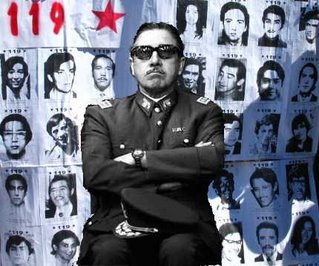


Pinochet had good contacts in the Chilean Supreme Court, and so many judges aided him by slowing down the legal accusations and putting obstacles into the investigation of the cases, but even so, Pinochet was put under house arrest on several occasions. Another scandal occurred in 2005, as during the course of an internal investigation by U.S authorities, nearly US$30 million appeared in secret bank accounts linked to Pinochet. The U.S. authorities were implementing the "Patriot Act" that was aimed at discovering possible accounts used by terrorists to finance their activities. While Allende was never accused of any acts of corruption, Pinochet´s family will inherit the legal accusations faced by Pinochet. Already many politicians are requesting that Pïnochet´s fortune be confiscated by the Chilean state.
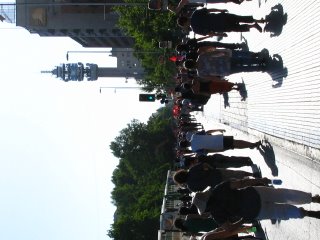


Chileans Celebrate Pinochet's Death
Rally on news of dictator's death at 91 turns violent

Santiago: Chile, Sunday, December 10, 2.35 p.m. local time

I was getting ready to indulge in what has become my favorite pastime this year, watching English Premier League on television. The match between Chelsea and Arsenal had just begun when I was rudely interrupted by a newsflash. The commentator said that the Military Hospital had announced that General Augusto Pinochet had died at 2:15 p.m. local time from heart complications.
My initial reaction was to get on my feet and cheer, but then I thought, "What if he is faking it again?" After all, Pinochet had been said to have been "dying" several times before. On TV I saw that people were gathering at "Plaza Italia," a central meeting point in the city where citizens gather to celebrate sporting victories or other important events. Meanwhile, the television showed the outside of the Military Hospital, where some Pinochet supporters were in tears.

A sudden rush of excitement took hold of me and I picked up my digital camera and headed off to the Plaza Italia. It was 4 p.m. when I arrived by bus (time was going fast). I saw people in cars blasting their horns towards Plaza Italia. When I got there, thousands of people were already celebrating, most of them left wingers with their traditional red flags.
Some fifteen minutes later I was outside La Moneda where some thousands of people had gathered. The riot police had formed a barrier to stop people from going near the palace. Some of the leaders of the left-wing parties were allowed to go to the palace; probably they went to ask for permission to march past it. This idea came too late as the heat and excitement made some of the marchers begin throwing missiles at the police, and obviously violence erupted. The police's water cannon vehicles got into action, but this only provoked the protesters even more, who began to set up barricades with whatever they could find. Later the police attacked with tear gas vehicles, which managed to disperse the crowd outside the Palace after about an hour of clashes.


The tear gas had hit me hard. I could not continue taking more photos, and after drinking my third can of beer, I headed out of the "combat zone". My impression is that today the majority of the Chilean people showed their anger against Pinochet and did indeed celebrate -- some more energetically than others.
It seems that Pinochet has some numerological connection with the number "11," He took part in the military coup in 1973 on Sept. 11 (which he did not organize and only joined at the last minute), and now his funeral will be on Dec. 11. There was a controversy over whether he will get a funeral as a former "head of state," but President Michelle Bachelet announced that there will be no such ceremony. Bachelet's father was a pro-Allende Air Force general who was tortured to death in prison some months after the coup.
Pinochet was appointed head of the Armed Forces by President Allende only fifteen days before Sept. 11, 1973, when the military took power. General Pinochet initially was the head of a military junta (a Spanish word that means gathering or group) formed by the head of the army, navy, air force and police.

From that date on he was the head of an undercover operation along with the military rulers of Argentina, Paraguay, and Uruguay, whose objective was to wipe out left-wing militants. "Operation Condor" led to the death of approximately 40,000 people in these countries, the most common method being the kidnapping of individuals who were then tortured to obtain information, and finally killed. Most of the left-wing militants' bodies were thrown into the sea from helicopters. After several years of street protests and guerrilla operations, Pinochet was forced to call for elections in 1988, which he lost, giving way for the 16-year rule of a center-left wing coalition of parties known as "Concertacion."

My personal opinion is that Chile will be much more peaceful after Pinochet's death. The curse is over, let's try to turn over the page and move forward together.

href="http://photos1.blogger.com/x/blogger/6198/4047/1600/868111/aucan123.jpg">
MAPUCHES DECLARE WAR ON MICROSOFT CORPORATION
Bill Gates sparks anger among Chilean natives

During an interview given by Aucan Huilcaman to AtinaChile (www.atinachile.cl) on August 12, 2005, the leader of the Mapuche nation denounced that he would sue Microsoft Corporation on behalf of his people since the software company planned to release a version of its “Windows XP” operating system in “Mapundungun” (the native language) without their authorization.
“We sent a letter to Bill Gates expressing our concern about this situation since we believe it is an act of intellectual piracy.We are the natural heirs of the Mapuche language and it is up to us to decide what we do with it. The Chilean government and Microsoft did not ask for our opinion on how to implement the Windows version, they just went ahead and did it,” said Huilcaman to Atinachile.
The elders of the Mapuche Nation carried out a ceremony called “Kimkeche Nutramkan” (gathering of Wise Men and Custodians of the Mapuche Culture) after which they agreed on sending the letter to Bill Gates that included the following paragraphs : “Mapundungun is a fundamental part of our culture and it is our right as an indigenous nation to preserve and develop our cultural heritage............Your decision to implement Windows in Mapundungun may be a good contribution to its technical-linguistic development, but the way it has been done has shown a total disrespect and lack of consultation with the Mapuche Nation.”
Since there was no reply from Bill Gates, Aucan Huilcaman presented several legal actions among others at the Interamerican Commission for Human Rights in Washington D.C and also in the Chilean Courts of Justice.
“I am not against Internet, I am only defending our Nation’s rights and culture, it is the speakers of Mapundungun that should decide whether our language is used in the Web or not.” said Huilcaman to Atinachile.
On Nov 23,2006 the Appeals Court in the city of Temuco, the heartland of the Mapuche territory, declared the “Protection Order” admisible and so the judges will study the case against Microsoft Windows XP and the Chilean Ministry of Education, that signed an agreement in October 2006 to launch the operating system in the Mapuche language.
The Mapuche are a native ethnic group that inhabit the south of Chile and Argentina. It is estimated that nearly 400,000 people speak Mapundungun at present. The Mapuches are an extremely warlike people that first resisted domination by the Inca empire and later by the Spaniards. During the past 5 years there have been many armed clashes between Mapuches and Chilean police over ownership of large areas of land claimed by the natives.

href="http://photos1.blogger.com/blogger/6198/4047/1600/overtraffic2.jpg">
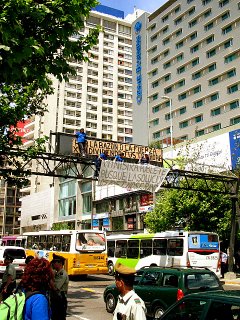
Chilean Women Defy Gravity To Get Better Housing
Housewives Climb On Top Of Traffic Signpost to protest

On Friday, Nov 3, a group of eight women that are members of Chile´s "National Association of Housing Debtors" (ANDHA in the Spanish acronym) carried out a spectacular protest in downtown Santiago, the Chilean capital. At approximately midday, the women climbed on top of a traffic signpost directly over the city's main avenue, the Alameda. The women declared to the reporters that gathered to cover the event that they would remain there until the Minister of Housing Patricia Poblete stopped a court order whereby their low income houses would be auctioned due to unpaid installments. Most of the women were also taking part in a temporary employment scheme for poor families called P.E.T that included sweeping streets, collecting litter and mowing lawns. ANDHA argues that their members will be unable to pay the monthly installments since these are far too high, the houses are of poor quality and also the majority were taking part in the P.E.T ., and since this plan was terminated a few months ago, the women are now without any stable sources of income.
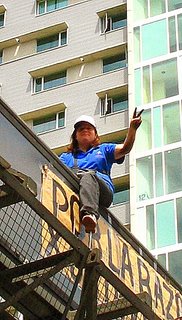
The group that climbed on top of the signpost were supported from the street by a group of nearly a hundred people that chanted slogans and insults against Minister Poblete, the police and the government. This is not the first time that ANDHA carries out this kind of actions, and the last time some of the women ended up jumping from a signpost towards a plastic landing bag set up by the police. At approximately 7:30 p.m. the police blocked the traffic with two buses, one water cannon truck and several patrol cars.


Some members of ANDHA on the street were arrested and then police officers used ladders to climb up to the signpost. A yellow landing bag was placed under the signpost and the officers forced the women to climb down. The whole operation lasted 45 minutes and none of the protesters were injured, but had to spend the night in detention. On Saturday night, members of ANDHA set up barricades near their homes with burning tires and clashed with the Police yet again

CHILEAN FOOTBALL

Kramer in court by La Tercera

Drugs, Fans and Chilean Football
Top Local Club Hit by Police Undercover Operation

An important sports promoter and the leader of an organized fan club linked to "Universidad de Chile", one of the country's most popular clubs have been arrested in connection with a drug trafficking organization. Jorge Barrera (35) and Claudio Hernandez (aka Kramer) were arrested on Nov. 16 in Santiago by officers of Chile´s "Investigaciones" (civilian police ). The plain clothed officers intercepted the two men in a car, and discovered a bag of 12 "Extasis" pills, cocaine and US$10,000 in cash. During the trial, the police officers stated that Barrera had dropped the Extasis pills to the ground, in order to deny responsability. The police also also stated that according to interceptions of mobile phone calls between the two accused Barrera wanted to buy from Kramer dosis of Extasis worth US$ 400. Jorge Barrera is the C.E.O of "Mercom", a company that specializes in sports marketing and representing professional football players. For the past four years , Mercom has been in charge of hiring players for "Universidad de Chile", such as Marcelo Salas, that was transferred in 2005 from River Plate of Argentina. Also several Colombian footballers such as Faustino Asprilla (that played for Parma (Italy) and Newcastle United among others), Mayer Candelo and Harly Alcazar arrived at Universidad de Chile after being hired by Mercom. Also Barrera has been responsible for transferring Chilean footballers such as Hugo Droguett to the Mexican league, where it seems he has good contacts. During the court hearing on Nov.21, Barrera was set free on bail for US$2000 after his lawyer argued that Barrera had to travel to Mexico for an important business meeting. The Judge allowed Barrera to travel to Mexico but he must return to Chile within ten days, after which he must report every week to Santiago police.
"He was in the wrong place at the wrong time. Kramer had promised Barrera to give him some tickets to the next Universidad de Chile match," said Rainiero Garcia, Barrera´s lawyer.
Claudio Hernandez, or "Kramer" as he is called by his friends, is one of the founding members of an organized fan club called "Los de Abajo", whose main activity is to support the club during matches. Kramer has had several criminal convictions such as carrying firearms, assault with bodily harm, damages to private property and now it seems he is linked to a drug trafficking organization that deals in "Extasis", an illegal drug that is sold for US$30 per pill in the Chilean market. After the trial, Kramer was sent into custody at Santiago´s “Maximum Security jail”.
"If a police officer is arrested for corruption, is all the Police force corrupt? Kramer may have made a mistake, but not all our fans are to blame," said "Anarkia", another leader of "Los de Abajo" during a TV interview.


ADIOS TO COACH NELSON ACOSTA
The friendly match played on Nov.15 between Chile and Paraguay was a good occasion to bid farewell to Nelson Acosta, coach of the national football team since 1996. As in other parts of the world many South American national teams used the occasion to prepare for future tournaments, such as the "Copa America" (South American Nations Cup) and the qualifying matches for the 2010 World Cup. The venue was the Sausalito Stadium in Vina del Mar, a ground that was incidentally built for the 1962 World Cup held in Chile.


The match itself could be used as a parallel for Nelson Acosta´s career as national team coach , full of ups and downs, with moments of glory and despair. By the first ten minutes of the second half, Chile was winning by 3-0, but in the next five minutes Paraguay scored twice, causing disapproval among the nearly 12,000 fans that showed up at the Sausalito. Near the end of the first half, Mauricio Pinilla,a striker with Hearts in the Scottish Premier league, had to be replaced since he had a muscle injury, a hard blow for Pinilla that is trying to recover his form and settle down to his new club.


However Chile managed to hang on and the man of the match was Jorge Valdivia,that scored the third goal and is currently playing for Palmeiras in the Brazilian First division.


Nelson Acosta was in fact born in Uruguay, and began his football career with Penarol, one of that country´s top clubs. In 1977 he moved to Chile where he played for Everton, O' Higgins and Fernandez Vial. Acosta began coaching with Fernandez Vial in 1984 and then continued with O'Higgins. In 1992 he began coaching Union Espanola, and led this club to be Chilean champions in 1993 and 1994. In 1996 Acosta had his first internacional success as he took Union Espanola to quarterfinals of the Copa Libertadores, the most important South American club tournament. Acosta had made himself a name at international level and in June 1996, he was brought in as a replacement for Xavier Azkargorta, Chile´s national team coach that was taking part in the qualifying rounds for the 1998 World Cup in France. Azkargorta had an awful campaign, and received violent criticism from the fans and press.


In Acosta´s first match in Santiago, Chile defeated Paraguay by 4-1 (ironically the same team he would face in his farewell match in 2006) and Acosta was hailed as a savior. Acosta managed to lead Chile to qualify for France 98, where the national team had a mediocre performance with draws against Italy (2-2), Austria (1-1) and Cameroon (1-1). In the next round Brazil (4-1) knocked Chile out of the competition and Acosta received some criticism by the press for not preparing for this match, since he took the players to a shopping center some hours before. It seems that Acosta had been satisfied with his performance and thought that he had done as much as he could. However, the Chilean Football Federation (ANFP) renewed his contract and Acosta continued as coach, this time with the responsibility of qualifying Chile to the 2002 World Cup in Korea and Japan. In 2000 Acosta qualified Chile to the Olympic Games in Sydney, Asutralia, where his team won the bronze medal. Then came the responsibility of qualifying Chile to the 2002 World Cup in Korea and Japan, that ended in disaster. In 2001, after a string of disappointing results, Acosta was replaced by a succession of two other coaches, but the national team was already in chaos and Chile did not qualify. During the qualifiers for Germany 2006, the starting coach was Juvenal Olmos, that also had a poor performance and so with a third of the matches left, Nelson Acosta was brought in as an emergency option. Acosta did raise the hopes among the fans with some positive results, but Olmos had already left Chile too far down the points ladder, and the gap with the other teams was made it impossible for Acosta to catch up. With the recent election of a new ANFP president, Harold Mayne-Nicholls, Acosta sensed he was not in Mayne-Nicholl´s plans and presented his resignation. To Acosta´s credit it can be said that he did qualify his adopted country to a World Cup, was very well liked by many players but hated by others, a fitting end to a respectable career.


Journalist Elected Head of Chilean Football
Harold Mayne-Nicholls Promises to Put House in Order

On Nov. 3, with an absolute majority of 47 votes in favor and one abstention, Harold Mayne-Nicholls was elected as new the President of Chile´s Football Federation (www.anfp.cl) for the next four years. The most important task for Mayne-Nicholls will be to recover Chilean football and put it back where it deserves to be. The finest moment for Chilean football was during 1950 to 1960, when the country had the most competitive league in South America and climaxed in 1962 when FIFA appointed Chile to host the fifth edition of the World Cup. New stadiums were built specially for the occasion and the home team got a respectable third place, after Brazil that won the event. Since then, very few stadiums have been built, and the current infrastructure is in decay. Also crowd violence has driven out many fans from going to see matches, which has had an impact on the revenues of professional clubs. The last time Chile qualified for a World Cup was in 1998 and since then the fans have seen a string of disappointing result. Compared to the rest of the South American nations, Chile has quite a balanced economy, as was proven during the qualifying matches for Germany 2006, where Chile had highest spectator attendance record in the continent. This means that the fans have money to spend to go and see matches, but who will want to go if they are in danger of being attacked by hooligans and will be seated in uncomfortable stadiums? This is precisely what Harold Mayne-Nicholls wants to change. During a recent TV interview, the new president of Chile´s football promised to "show zero tolerance with hooligans, a prosecuting office will be set up to punish these people that only want to cause destruction. If they want to make trouble, they will have to go somewhere else."


The main pillars of Mayne-Nicholls modernization plan will be :
1) After carrying out opinion polls among the fans, a new tournament system for the first division will begin in 2008. Since Chile has such a vast territory, some teams must travel thousands of kilometers to play official matches. An idea is to divide the teams into North , Central and Southern groups from which the best teams will move on to a play-off stage.
2) A Director for the National Team will be appointed, whose task will be to oversee development of the players from youth to adult level.It seems most probable that current coach Nelson Acosta will not continue, since Mayne-Nicholls favors Manuel Pellegrini, that is the coach of Villarreal in the Spanish first division.
3) Stamp out violence from stadiums and improve its infrastructure. Chile will honor its commitment to stage the U-20 Women's World Cup in 2008.
Harold Mayne-Nicholls was born in 1961 and has an impeccable career as a football official. Mayne-Nicholls is a graduate in journalism from Chile´s Catholic University, and his first job was as an official of the University's professional football team, one of the most popular in the country. After a spell in the South American Football Federation (Conmebol), Mayne-Nicholls moved up the ranks and joined FIFA , the world's most important sports institution. During the past World Cup, Mayne-Nicholls was in charge of organizing the opening ceremony and the matches in Munich. At present he is also in charge of FIFA´s Goal Project for South America.

Thursday, November 02, 2006

Central American News

Nicaragua Plans To Build New Interocean Canal
Will the Panama Canal go out of business?

On the weekend of Oct.22, the citizens of Panama approved the expansion plans for the interoceanic canal that has been in operation for the past 92 years. One of the main reasons for this result was the news that one of its neighboring countries, Nicaragua, is also very near to beginning construction of an alternative passage through its territory, that will allow ships of higher tonnage to cross from the Atlantic to the Pacific Ocean and vice versa. In the mid nineteenth century , Nicaragua had been the first option to build a canal, but it was discarded due to the technological limitations of that time, instead Panama was chosen and the Canal was inaugurated in 1914.
Other countries that may be affected are Argentina and Chile, since at present some of the more modern vessels and supertankers cannot pass through the Panama Canal, and must circumnavigate around the Cape Horn, a 36 day trip that increases costs by approximately US$2 million. The main advantage of building a canal through Nicaragua is that the route between New York and California will be shortened by 800 kilometers and will also reduce costs for ships that travel between Asia and Europe. Even with the recently approved expansion plans that will give the Panama Canal a new length of 80 kilometers and the capacity to allow ships of up to 130,000 tons, the Nicaragua Canal will have a capacity for ships of up to 250,000 tons.
At the beginning of this month, the President of Nicaragua , Enrique Bolaños presented the project during an international defense conference . "This is a matter of continental security. What was a dream before, can now become a reality," said Bolanos. Also the Nicaraguan government has set up a "Commission for a Great Interoceannic Canal Through Nicaragua", that has identified the most convenient route. (see map). The canal will have a length of 286 meters, including an 80 km stretch with special dikes that will cross through Lake Nicaragua, the biggest in Central America. Ships will take 26 hours to cross the new canal, compared to the current 8 hours through Panama. The Nicaragua Canal would begin operations in 2019, and its construction will cost US$18 billion, that will be invested by local and foreign companies. During the construction, 40,000 direct jobs will be created and for its operation, the Canal will employ between 5,000 to 10,000 people. The project estimates that by 2025, the "Great Canal" will allow the transit of 573 million tons of cargo , or 4,5 % of global trade. The canal will increase Nicaragua's per capita income will increase from today's US$ 857 to US$2258 in 2025. An estimated US$300 million will be invested to preserve the tropical jungles and the habitat of native communities, as 40,000 square kilometers will be reforested.

Brazilian Footballers

Kaka Helps A.C Milan Destroy Anderlecht
Brazilian footballer scores three goals in Champions League

On November 1, it was A.C Milan's turn to play host to Belgian champions Anderlecht at the Giusseppe Meazza Stadium. It was one of the matches in Group H of this year's edition of the UEFA Champions league, Europe's most important club championship. A.C Milan had defeated Anderlecht by 1-0 in Brussels and so this was the last chance for the Belgians to get a good result and continue in the competition. The action began very badly for Anderlecht since in the sixth minute Alberto Gilardino was fouled in the area by a Belgian defender and Brazilian midfielder Kaka scored the penalty past goalkeeper Daniel Zitka. A.C Milan had come out to secure the result as early as possible and continued to harass the Anderlecht goal. In the 19th minute defender Alessandro Nesta went out injured and was replaced by another Brazilian, Cafu. Just three minutes later Kaka broke away clear on the right wing and received a good return pass from Cafu to place the ball into the Belgian net. Anderlecht was inoffensive for the rest of the first half and A.C Milan controlled the field.
It seems that the Belgian players were given some inspiration by their coach during the break as they showed a much more aggressive attitude in the second half and had two good chances that were missed by Tchite whose shots were off target.However,in the 55th minute Kaka struck a heavy blow as he ran down the left wing, sidestepped to his right and from near the edge of the area sent the ball with hard shot into the top right corner of Zitka´s goal. This goal must surely be included in the "Best goal competition" for this edition of the Champions league. Anderlecht had woken up and continued trying to score and in the 60th minute Juhasz headed in the ball past Brazilian goalkeeper Dida . From then on there were several dangerous situations on both sides of the pitch and also A.C Milan sent on two 2006 World Champions, Gennaro Gattuso and Andrea Pirlo.
It was Gilardino, another member of Italy's recent World Cup squad that wrapped up the match for A.C Milan in the 87th minute as he volleyed in a great pass by Pirlo. Maybe if Anderlecht had shown in the first half the attitude of the second half, a different story could have been written in Milan.